The AI Subscription Honeymoon Is Over (and That’s Fine)
By Luke O'Regan
Published
The free lunch had a meter running the whole time. We just weren’t looking at it.
For the last couple of years, AI coding tools have felt like an all-you-can-eat buffet. Pay a flat monthly fee, throw every task at the smartest model going, and never think about it. That is changing. Cursor is now sold as part of the X Subscription, and its plans include a weekly pool of usage for Cursor’s own models. Third-party models sit outside that pool. On Premium and above you pay API list price for them, drawn from prepaid credit.1
I’m a designer and full-stack dev with a three-year-old, so my time and my money both get audited. Here is what I pay and how I keep the bill sensible.
What is changing
I’m not the only one who feels it. Martin Adams asked on X whether anyone else sensed the AI subscription honeymoon coming to an end, and listed Cursor’s API rates for non-Grok models among his examples.2
Anyway else get the feeling that the AI subscription honeymoon is coming to an end.
— Martin Adams | Building Flowtelic (@Martin_Adams) November 1, 2026
Cursor ➡ API rates for non-Grok models
Claude ➡ Removal of the 20x plan
ChatGPT ➡ Codex and ChatGPT now have the same limit, so your coding agent can cut off your web searches
The old deal was one flat fee, with the vendor absorbing your heavy days. Now the bill comes in two parts. Cursor’s own models, Grok and Composer, come out of an included weekly pool that Grok and Cursor share. Everything else is billed at the model provider’s API price.1
The New Stack sums up the catch: the bundle promises more Grok usage for less, but if you prefer rival models, Claude now costs extra.3 The $8 Plus tier covers only Cursor’s own models. To use third-party models you need Premium ($30 a month) or higher, which is also where you can choose effort levels.1
I don’t think this is sinister, and it is more honest, because the price now follows the usage. It does mean the model you pick is now a spending decision.
What I use, and what I pay
- Cursor for day-to-day coding.
- Hermes Agent running Claude and Grok for agent work and side projects.4
- The X Subscription at £30 a month. It covers Grok, Cursor and X Premium, plus Grok Bot and the image, video, audio and transcription tools. Cursor’s docs say Grok Chat, Imagine, Voice, Grok Bot and Cursor all draw from the same weekly pool.1
- Claude Code5 on a Pro plan, which I pay for separately at £18 a month.
That is £48 a month, and I stay almost entirely inside what the subscriptions include. For that I get the editor I live in, an agent that does real work for me, and a second model family for when Grok is not the right tool. For me that is a fair price, and it is the number I would have to justify if the hours stopped adding up. Here are the last 30 days from my X Subscription usage page:
| Last 30 days (4 Oct to 2 Nov) | Tokens | Included | Extra credit used |
|---|---|---|---|
| Everything (X Subscription) | 359.4M | 359.3M | $0.15 |
| Cursor only | 250.6M | 250.6M | $0 |
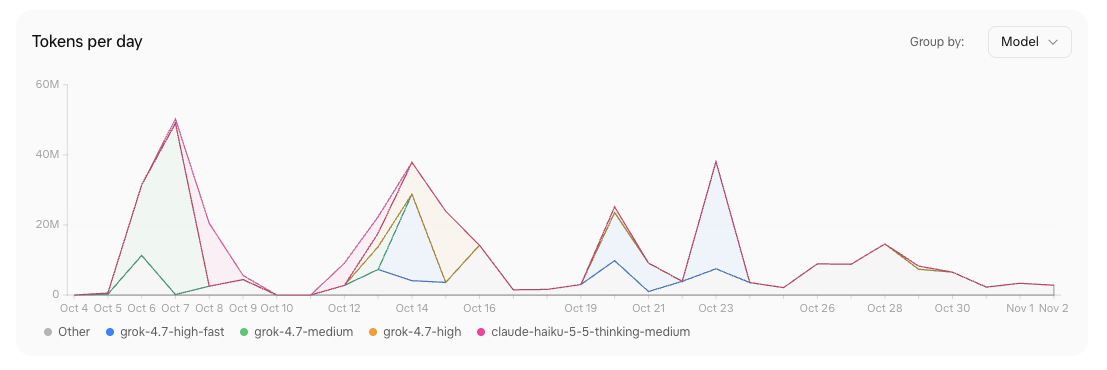
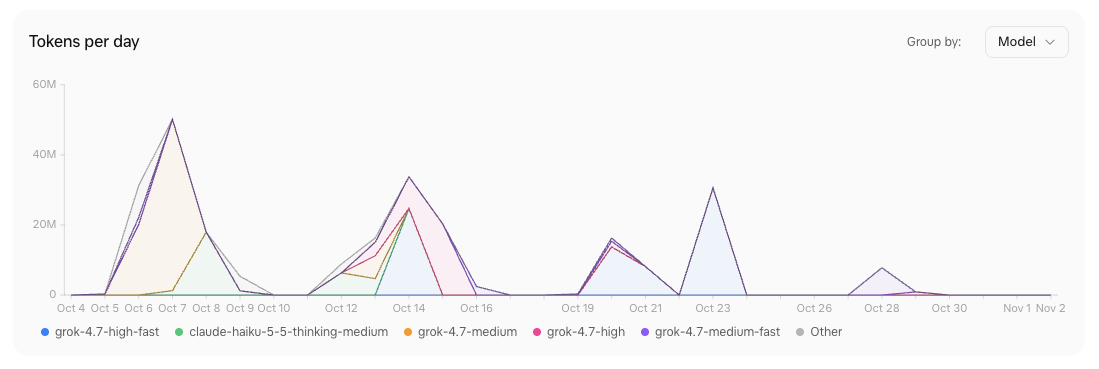
What the charts show
My usage is a handful of tall spikes with quiet days in between. The biggest, on 7 October, was around 50M tokens. Those spikes were heavy days on bigger pieces of work, mostly improvements and bug fixes for client websites. The one on 23 October was personal: the day I started setting up Szandra’s website.
That is why a flat plan can still make sense for me. It has to cover my busiest weeks, not my average one, and so far it has. On a flat plan I pay for the quiet days too, and that is the trade for having the spikes covered.
Stop looking at benchmarks, start looking at cost per task
Benchmarks get the headlines. Cost per task gets my money.
By cost per task I mean the whole bill for one finished job: the tokens, the retries when it gets something wrong, and the time you spend checking the result. A cheap model that needs three attempts is not cheap. An expensive model that nails it first time sometimes is.
When I compared two models for Hermes, I didn’t keep logs, but my rough estimate put one at nearly three times the cost per task of the other. It is an estimate, not a measurement.
Here is why that matters, with made-up round numbers to show the maths. Say one model finishes a job for 20p and another for 60p. At 30 jobs a day, that is £6 against £18. Over a 20-day month, £120 against £360, for the same output.
Inside a flat pool you won’t see pence at all. You see how fast the pool drains. The same thinking still works, because the model that finishes the job with fewer tokens leaves more pool for the rest of the week. Use a third-party model, or run past the pool, and the maths gets literal: third-party models are billed at API list price from the first request, and extra Cursor-model usage is billed at Cursor’s published rates.1
You can get a real figure for your own work quickly:
- Pick one repeatable job, such as fixing a small bug or writing a component.
- Run it on two models with the same instructions.
- Note what your usage page says before and after, and how many attempts each needed.
Asking “what does it cost to get this done?” instead of “which model is smartest?” changes how you use these tools.
How I keep it sane
- Medium effort by default. Medium handles most real work and is faster, and lower effort usually burns fewer tokens, which is what you pay for. I turn it up when I am properly stuck.
- The cheapest model that can handle the job. Renaming variables doesn’t need a genius. I save the expensive models for hard problems and step up only when the cheaper one has had a fair go.
- Better instructions. A cheap model with a clear spec can beat an expensive model with a vague prompt. Say what you want, what the constraints are and what done looks like. Half my “this model is rubbish” moments were really “my prompt is rubbish” moments, and every retry costs usage.
- Cutting what I don’t use. I have tried loads of AI tools this year and quietly uninstalled most of them. If something isn’t saving me real hours, it goes, because a subscription you forgot about costs the same as one you use daily.
Is it worth paying?
Paying for AI tools is fair. Used well, they save real hours, and good tools cost money to run. The honeymoon was always going to end.
What matters is knowing which tools earn their keep. A rough test: would you miss it after a week without it? If you can’t remember the last time you opened it, it goes.
So what are you paying for, and what did you cancel? I’m always looking for a better setup.
For the record, I have no affiliate or paid relationship with Cursor, X or Anthropic. This is just my opinion.